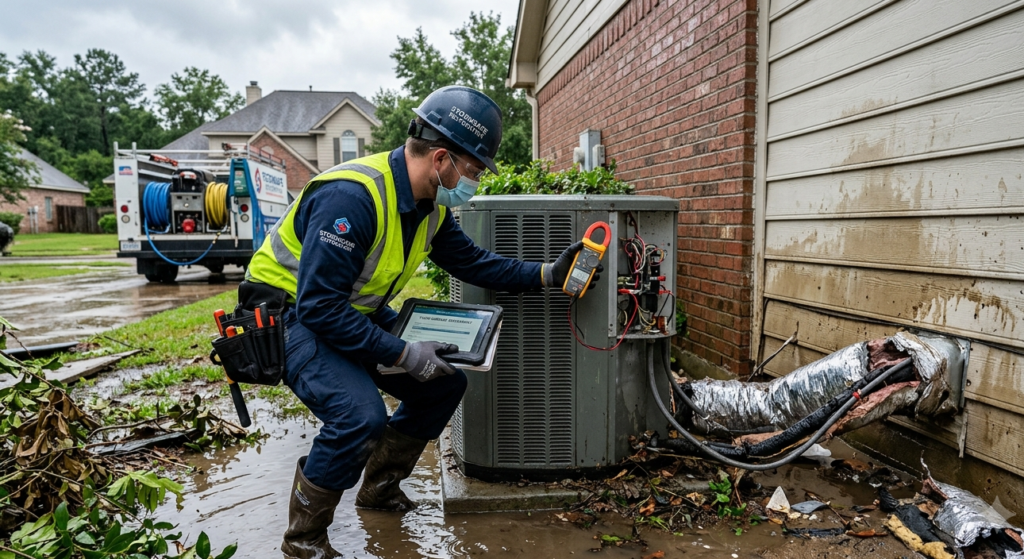
After a flood, most homeowners focus on the visible damage – soaked carpets, waterlogged walls, ruined furniture. What often gets overlooked until it causes a much bigger problem is the HVAC system. Restarting a flood-affected HVAC unit without proper inspection and remediation is one of the most common – and costly – mistakes homeowners make after a water event.
Here’s what flooding does to your system, why it matters more in the Southeast’s humid climate, and the right sequence of steps before you turn anything back on.
What Flooding Does to an HVAC System
HVAC systems have multiple points of vulnerability to water damage:
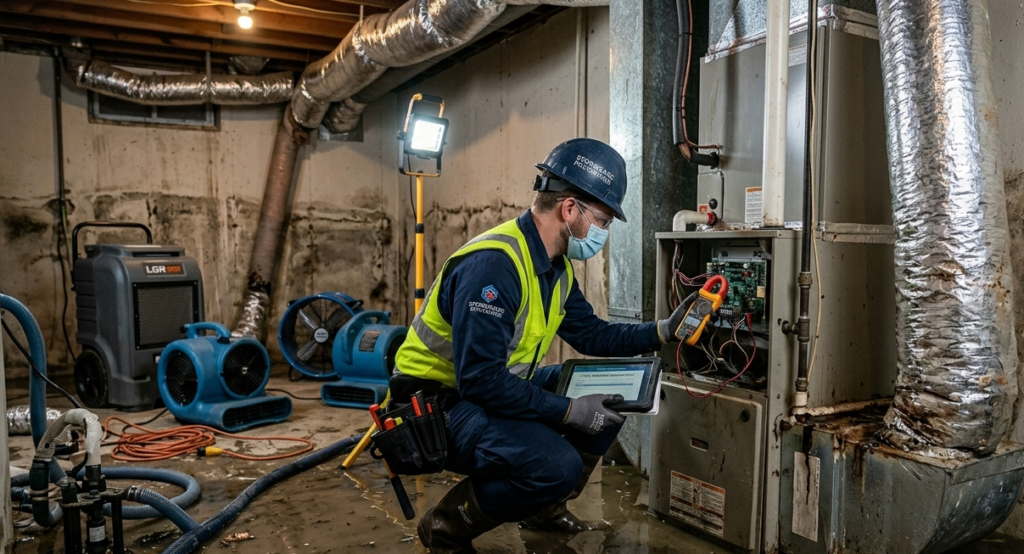
Air handler and furnace units located in basements, crawl spaces, or utility closets are often the first to flood. Water intrusion into the air handler saturates the blower motor, damages electrical components and control boards, corrodes heat exchangers, and soaks the air filter and evaporator coil housing.
Ductwork is particularly problematic. Flex duct – the spiral-reinforced insulated duct used in most residential systems – absorbs water into its fibreglass insulation liner and never fully dries out on its own. Rigid sheet metal duct can trap standing water at low points and joints.
Outdoor condenser units are designed to tolerate rain but not submersion. If the condenser unit was flooded (water above the base pan), the compressor, capacitor, and contactor are all at risk. Salt water from coastal storm surge is especially corrosive.
Thermostats and zone controllers that use low-voltage wiring are highly sensitive to water exposure – even brief saturation can cause short circuits that aren’t immediately apparent.
Why the Southeast Adds an Extra Layer of Risk
In Georgia, Florida, and the broader coastal Southeast, HVAC systems run significantly more hours per year than in cooler climates. They’re also working in conditions of high ambient humidity – meaning the system’s dehumidification function is critical to maintaining indoor air quality, not just comfort.
A flood-affected duct system in these climates becomes a mold incubator within days. The ductwork carries conditioned air to every room in the home – meaning a contaminated duct system distributes mold spores throughout the entire structure every time the system runs. This is why HVAC remediation after flooding in the Southeast cannot wait for “a convenient time.”
Homeowners throughout the region – from Warwick County, Georgia down to the Florida coast – face this scenario after every significant storm season. Providers coordinating full property restoration, including those handling water damage repair in Daytona Beach FL, frequently identify HVAC systems as a critical remediation component that gets missed when homeowners attempt to manage flood recovery themselves.
The Pre-Restart Checklist
Before you turn your HVAC system back on after any flooding event, work through this sequence:
1. Disconnect power first. Turn off the circuit breakers for both the air handler/furnace and the outdoor condenser before inspecting anything. Never assume the system is off because the thermostat is set to OFF.
2. Inspect the air handler for visible water damage. Check for water lines, rust, debris, and standing water in the drain pan. If the unit was submerged above the lowest electrical component, plan for component replacement rather than just cleaning.
3. Inspect all accessible ductwork. Look for water lines, standing water at low points, and any visible mold or debris inside supply and return registers. Flex duct that was submerged should be replaced – it cannot be adequately dried or sanitised in place.
4. Have the electrical components tested before re-energising. A licensed HVAC technician should test capacitors, contactors, control boards, and wiring with a multimeter before the system is powered on. Energising a wet or corroded control board can cause immediate failure and potential fire risk.
5. Replace the air filter. This is non-negotiable – the filter acts as a capture point for mold spores, debris, and flood contaminants during operation.
6. Schedule a duct cleaning and antimicrobial treatment. After the system is confirmed electrically sound, all ductwork should be professionally cleaned and treated with an EPA-registered antimicrobial agent before the system runs in occupied spaces.
According to the EPA’s guide to mold in HVAC systems, HVAC systems are one of the primary pathways for mold distribution in water-damaged structures – and remediation that addresses the structure but not the duct system is incomplete.
When to Replace vs. Repair
The replacement-vs-repair decision after flood damage depends on three factors: the submersion depth, the duration of contact, and the age and condition of the equipment before the event.
As a general guideline:
- Air handlers submerged above the blower motor for more than a few hours: replacement typically more cost-effective than component repair
- Outdoor condensers submerged above the refrigerant access valves: compressor and electrical components typically require replacement
- Ductwork that cannot be thoroughly dried within 48 hours: replace flex duct sections; clean and treat rigid duct
- Systems over 12–15 years old with pre-existing maintenance issues: flooding is typically the catalyst for full system replacement
Your HVAC technician should provide a written assessment with photographic documentation before any repair work begins – this documentation supports your insurance claim.
Conclusion
Restarting a flood-affected HVAC system without proper inspection is how a $3,000 restoration job turns into a $15,000 duct remediation and mold treatment. In the Southeast’s climate, the risk is compressed – humid conditions make the window between “wet ductwork” and “active mold contamination” extremely short. Get your system assessed by a licensed HVAC contractor before you run it, and coordinate that assessment with the broader water damage restoration scope so nothing gets missed.
HVAC Contractor Warwick GA provides residential and commercial HVAC installation, repair, and flood-damage assessment services in Warwick and surrounding Georgia communities. Licensed and insured.
Leave a Reply